The Details
• Botanical Name: Epipremnum aureum 'N'Joy'
• Common Name: N'Joy Pothos, N'Joy Devil's Ivy
• Pot Size: 130mm Nursery Pot
• Plant Type: Tropical Evergreen Climbing Vine
Light
The N'Joy Pothos thrives in bright, indirect light, which helps maintain its beautiful creamy-white and green variegation.
Position it near a bright window where it receives plenty of natural light without being exposed to harsh direct afternoon sunlight. Gentle morning sunlight is generally well tolerated and can help encourage healthy, compact growth.
Although the N'Joy can tolerate moderate indirect light, its heavily variegated foliage contains less chlorophyll than an entirely green Pothos, meaning it benefits from a brighter position to support healthy growth.
In insufficient light, growth may slow, new leaves may become smaller and the plant may produce more green foliage.
Avoid prolonged exposure to intense direct sunlight, particularly during Melbourne's warmer months, as the delicate white portions of the leaves are more susceptible to scorching.
Watering
The N'Joy Pothos prefers its potting mix to dry out slightly between waterings rather than remaining constantly wet.
Allow approximately the top third to half of the potting mix to dry before watering thoroughly, ensuring excess water can drain freely from the bottom of the pot.
During spring and summer, when temperatures are warmer and the plant is actively growing, you may find it requires more frequent watering.
As growth slows during autumn and winter, reduce watering accordingly and allow the mix to dry a little further between drinks.
Avoid keeping the roots constantly saturated, as prolonged moisture can lead to root rot.
While the N'Joy can tolerate occasional periods of dryness, repeated severe dehydration may cause leaves to curl, wilt or develop crispy edges.
The best approach is to check the moisture level of the potting mix rather than relying on a fixed watering schedule.
Feeding
Feed your N'Joy Pothos with a diluted, balanced liquid fertiliser approximately every 4–6 weeks throughout spring and summer to encourage healthy foliage and steady growth.
During autumn and winter, reduce the frequency and strength of feeding to suit the plant's slower growth and lower light levels.
If your plant continues growing actively in a warm, well-lit indoor environment, occasional light feeding can still be beneficial.
Avoid overfertilising, as excessive nutrient concentrations can damage the roots and contribute to browning leaf edges.
Growing
The N'Joy Pothos is a naturally climbing tropical vine that can also be grown as a beautiful trailing houseplant.
Its compact, heart-shaped leaves grow along flexible stems, gradually creating a cascading display when positioned in a hanging basket or on an elevated shelf.
Alternatively, provide a moss pole, trellis or other suitable support to encourage the plant to climb. Like other Pothos varieties, it produces aerial roots that can attach to supports, and its leaves may become larger under favourable climbing conditions.
The N'Joy is generally a slower grower than some of the more vigorous green Pothos varieties, largely due to its variegated foliage.
It prefers a loose, airy and well-draining potting mix that retains some moisture without becoming compacted or waterlogged. A combination of quality organic potting material with ingredients such as orchid bark, perlite or pumice provides a suitable balance of moisture retention and aeration.
Warm indoor temperatures and moderate humidity are ideal, although this adaptable plant generally performs well in typical household conditions.
Avoid cold draughts, sudden temperature fluctuations and prolonged exposure to temperatures below approximately 15°C.
Occasional trimming can encourage branching and help maintain a fuller appearance, while healthy stem cuttings can be propagated using nodes.
Pet Friendly?
No. The N'Joy Pothos is toxic to cats and dogs if chewed or ingested.
Like other members of the Araceae family, Epipremnum aureum contains insoluble calcium oxalate crystals that can cause irritation and discomfort when plant material is chewed.
Symptoms may include oral irritation, drooling, pawing at the mouth, vomiting and difficulty swallowing.
We recommend keeping this plant safely out of reach of curious pets and small children.
If you suspect your pet has ingested any part of the plant, contact your veterinarian for advice.
Good to Know
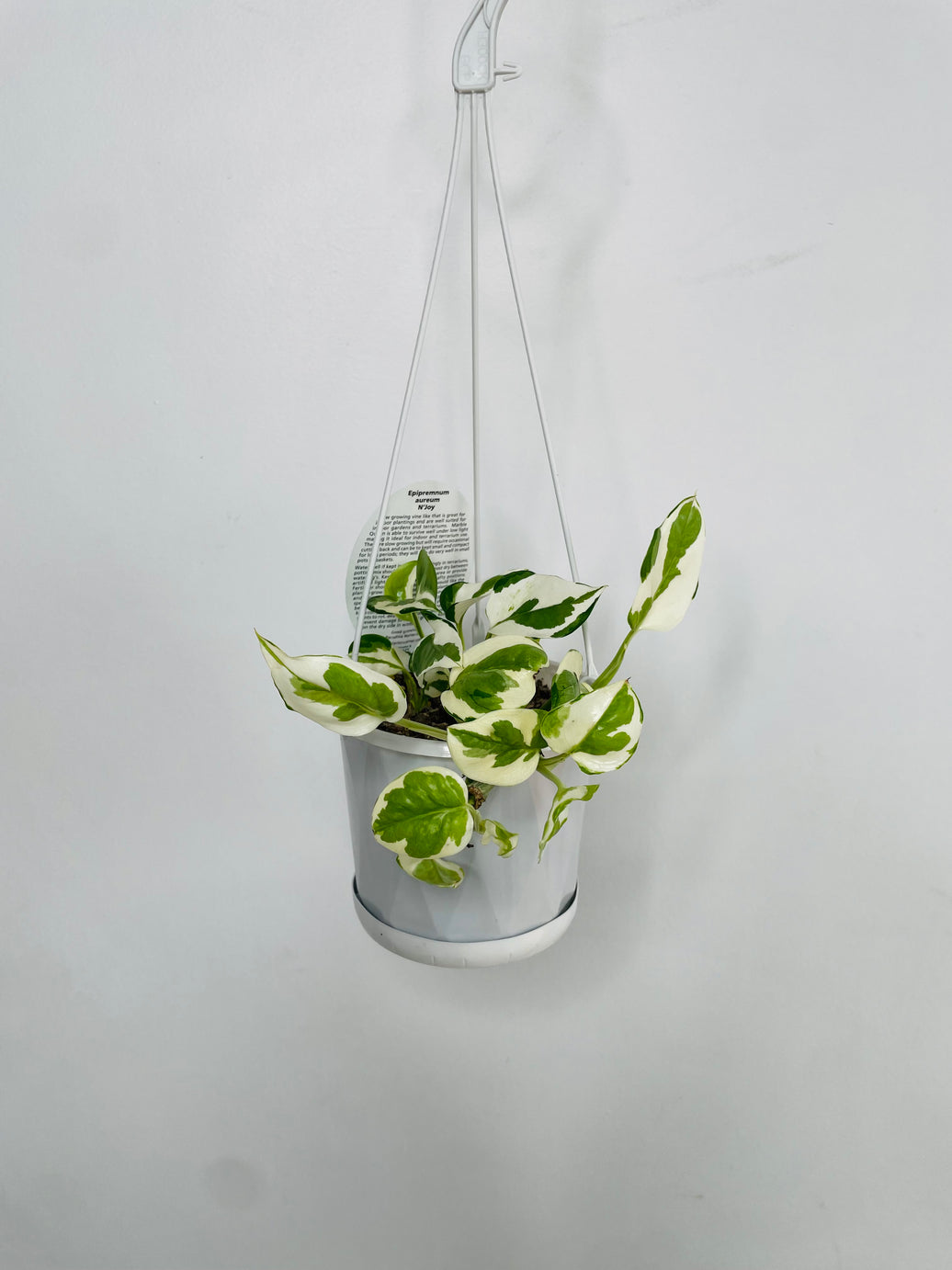
The N'Joy Pothos is a cultivated selection of Epipremnum aureum, prized for its distinctive white-and-green variegation and compact foliage. Its beautifully contrasting leaves make it particularly effective when displayed alongside darker green houseplants.
Each leaf develops its own individual pattern, meaning no two leaves will look exactly alike. Some may feature broad areas of creamy white, while others display more intricate patches of green. This natural variation is part of what makes the N'Joy so appealing.
Because the white sections of its foliage contain little to no chlorophyll, providing sufficient bright, indirect light is especially important for maintaining healthy growth.
The N'Joy is sometimes confused with other variegated Pothos varieties, particularly 'Pearls and Jade' and 'Glacier'. However, its relatively clean, well-defined patches of green and creamy white are a characteristic feature of this beautiful cultivar.
As the plant grows, its trailing stems can be trimmed to maintain a compact shape or left to cascade naturally. Cuttings containing healthy nodes can also be propagated to create new plants or fill out an existing pot.
• We photograph as many of our plants as possible; however, some listings may occasionally use supplier images.
• As plants are living things, every plant is unique and natural variations in size, colour and fullness should be expected.
• The plant you receive may not be the exact one pictured, but we'll always hand-pick a beautiful, healthy plant we'd happily display in our own home.