The Details
• Botanical Name: Ficus longifolia (commonly sold under this name; often associated with Ficus binnendijkii)
• Common Name: Sabre Fig, Long Leaf Fig
• Pot Size: 300mm Nursery Pot
• Plant Type: Tropical Evergreen Tree / Indoor Foliage Plant
Light
The Sabre Fig is a light-loving indoor tree that performs best in a bright position with plenty of natural light throughout the day.
Bright, indirect light is ideal, encouraging healthy foliage, strong branching and the development of its beautiful, elongated leaves.
A position near a large east-facing window or a little back from a bright north-facing window is an excellent choice.
Unlike some more shade-tolerant indoor plants, Ficus varieties generally appreciate generous light levels and can struggle when positioned too far from a window.
A little gentle morning sunlight is usually beneficial, particularly when the plant has been gradually acclimatised.
However, avoid suddenly exposing a plant grown indoors to intense direct sunlight, especially during Melbourne's warmer months. Harsh afternoon sun can scorch the foliage, leaving pale patches or crispy brown markings.
The Sabre Fig can tolerate moderate indoor light, but growth may slow and the canopy may gradually become less dense if the position is too dim.
If you notice excessive leaf drop, sparse new growth or branches stretching towards the nearest window, the plant may benefit from a brighter location.
Once you've found a suitable position, try to keep your Sabre Fig there. Like many Ficus varieties, it can be sensitive to sudden changes in lighting and environment.
For the healthiest, fullest growth, plenty of bright, filtered natural light is the key.
Watering
Sabre Figs appreciate a consistent watering routine, but they don't enjoy sitting in constantly wet soil.
Allow approximately the upper third of the potting mix to dry before watering thoroughly, ensuring excess water can drain freely from the bottom of the nursery pot.
The goal is to maintain a balance between providing enough moisture to support healthy foliage and allowing sufficient oxygen to circulate around the roots.
During spring and summer, when temperatures are warmer and the plant is actively growing, watering will generally be required more frequently.
In autumn and winter, reduce watering as growth slows and the potting mix takes longer to dry.
Avoid allowing the entire root ball to remain completely dry for extended periods, particularly during warm weather, as this may lead to leaf drop and stressed foliage.
Equally, consistently saturated soil can cause root rot, yellowing leaves and declining growth.
Always check the moisture level before watering rather than relying on a strict weekly schedule.
For a large, established plant like this one, remember that the surface of the potting mix may dry considerably faster than the deeper root zone. Checking moisture several centimetres below the surface will help prevent overwatering.
If you're displaying your Sabre Fig inside a decorative cover pot, always remove any excess water that collects at the bottom.
Ficus plants can occasionally shed leaves when their watering routine changes suddenly. Maintaining reasonably consistent conditions will help minimise unnecessary stress.
Feeding
With its generous canopy and potential for substantial growth, the Sabre Fig appreciates regular feeding to maintain strong, healthy foliage.
During spring and summer, apply a balanced liquid fertiliser formulated for indoor plants approximately every 2–4 weeks, following the manufacturer's recommended dilution.
This helps replenish nutrients in the potting mix and supports healthy root development, strong stems and the production of fresh leaves.
During autumn and winter, reduce the strength and frequency of feeding to match the plant's slower growth.
If your Sabre Fig continues producing new foliage throughout the cooler months in a warm, well-lit indoor environment, occasional light feeding can still be beneficial.
Avoid excessive fertiliser applications, as nutrient and salt build-up can damage the roots and contribute to brown leaf tips or declining foliage.
A regular, gentle feeding routine is generally more beneficial than occasional heavy applications.
Growing
The Sabre Fig is a tropical evergreen tree belonging to the Moraceae family, making it a relative of other popular indoor Ficus varieties, including the Fiddle Leaf Fig, Rubber Plant and Weeping Fig.
It is commonly sold as Ficus longifolia, although plants in this group are also associated with the botanical names Ficus binnendijkii and Ficus maclellandii in horticulture.
Unlike broad-leaved Ficus varieties, the Sabre Fig develops distinctive, elongated leaves that are narrow, pointed and beautifully arching.
These leaves emerge along slender branches, gradually forming a dense, flowing canopy that gives the plant its characteristic soft, almost willow-like appearance.
As the plant matures, its stems become increasingly woody and substantial, creating the structure of a small indoor tree.
Under favourable conditions, Sabre Figs can eventually grow several metres tall indoors, although their size can be managed through careful pruning.
Their naturally branching growth makes them particularly suitable for creating large, leafy statement plants.
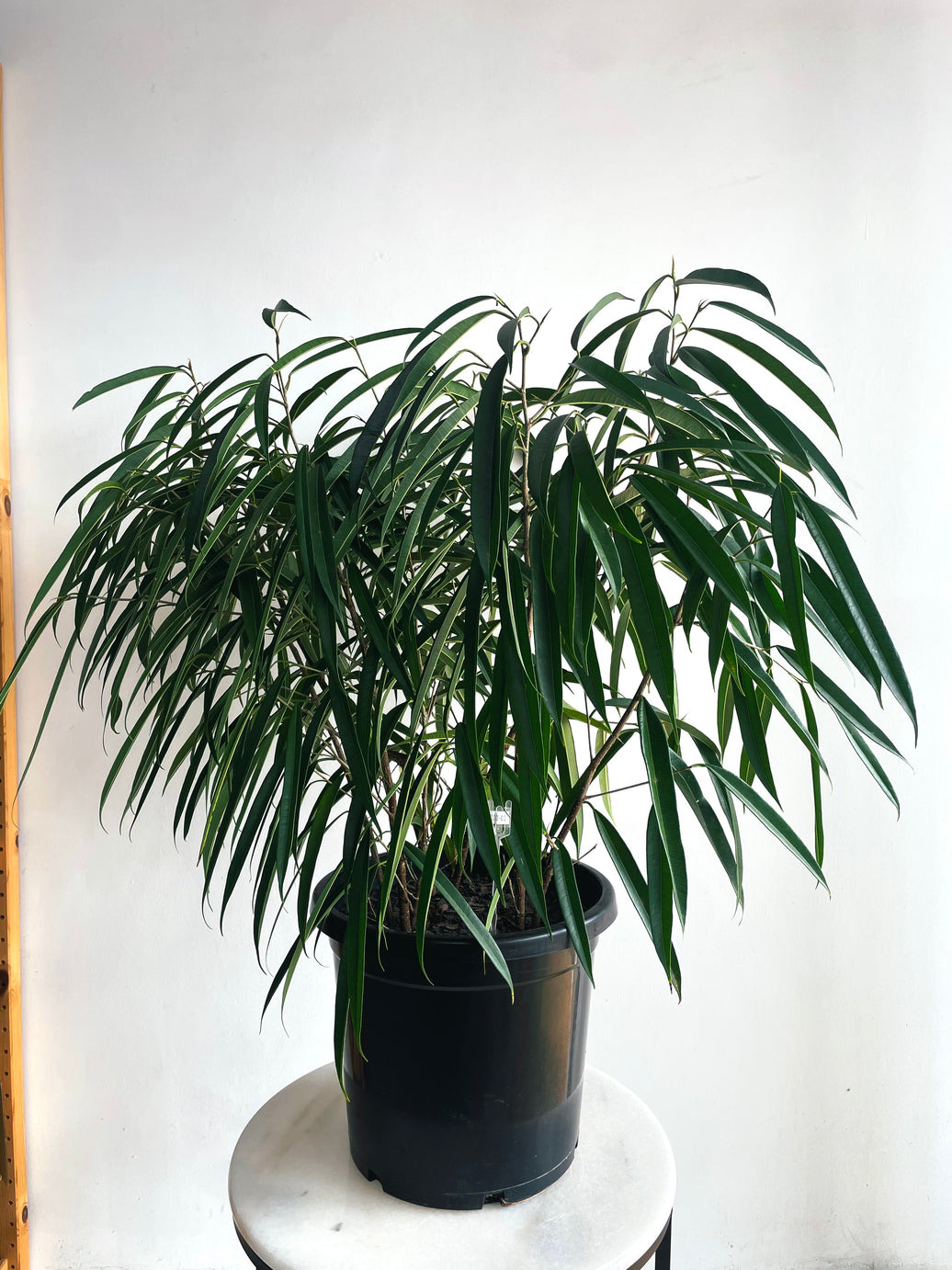
This particular specimen features an impressive, established canopy with multiple branches and an abundance of long, glossy leaves, making it an excellent choice for filling a larger indoor space.
For healthy growth, use a quality, well-draining potting mix that provides adequate aeration around the roots while retaining a moderate amount of moisture.
Our Minty Greenhouse Core Indoor Mix is a suitable choice, providing a balanced growing environment for healthy root development.
Sabre Figs prefer warm, stable indoor temperatures and should be protected from cold draughts, heating vents and sudden temperature changes.
They generally tolerate average household humidity, although moderate humidity can help maintain healthier foliage and reduce the likelihood of dry leaf edges.
Occasionally wipe the leaves with a soft, damp cloth to remove accumulated dust and keep them looking their best.
As the plant grows, pruning can be used to maintain its shape, control height and encourage a fuller canopy. Pruning is best carried out during the warmer growing season when the plant is actively producing new growth.
Like other Ficus varieties, the Sabre Fig produces a milky sap when its stems or leaves are cut. This sap can irritate the skin, so wearing gloves when pruning is recommended.
Repot when the plant becomes noticeably root-bound, ideally during spring or summer. Choose a pot only slightly larger than the existing root ball to avoid excessive moisture retention.
With consistent care and a suitable position, this beautiful indoor tree can become an increasingly impressive feature in your home for many years.
Pet Friendly?
No. Sabre Figs are toxic to cats and dogs if ingested.
Like other Ficus varieties, the Sabre Fig contains a milky latex sap that can cause irritation and gastrointestinal upset.
Possible symptoms include excessive drooling, vomiting, diarrhoea and irritation around the mouth.
The sap may also cause skin irritation in sensitive individuals.
We recommend keeping this plant away from curious cats and dogs, particularly those that enjoy chewing foliage.
If you suspect your pet has ingested part of the plant, contact your veterinarian for advice.
Good to Know
The Sabre Fig is particularly loved for its unusual, elongated foliage, which creates a softer and more flowing appearance than many traditional indoor trees.
Its long, narrow leaves naturally arch and hang from the branches, giving the plant a relaxed, almost willow-like silhouette.
As new leaves emerge, they may appear lighter green before gradually developing the deeper, glossy colour of mature foliage.
Like many Ficus varieties, the Sabre Fig can be sensitive to sudden environmental changes. Moving it to a new position, particularly one with different light levels or temperatures, may occasionally cause some leaf drop while the plant adjusts.
This doesn't necessarily mean something is wrong. Provided the growing conditions are suitable, the plant will often settle into its new environment and resume healthy growth.
Once you've found a bright, comfortable position, keeping the plant there will generally produce the best results.
The Sabre Fig is also sometimes sold under different botanical names, particularly Ficus binnendijkii and Ficus maclellandii, so you may encounter these names when researching its care.
The plant pictured is a beautifully established specimen with a broad, bushy canopy, multiple woody branches and an abundance of long, deep green leaves. Its generous 300mm nursery pot makes it a fantastic ready-to-style statement plant for larger living rooms, offices and indoor spaces.
• We photograph as many of our plants as possible; however, some listings may occasionally use supplier images.
• As plants are living things, every plant is unique and natural variations in size, colour and fullness should be expected.
• The plant you receive may not be the exact one pictured, but we'll always hand-pick a beautiful, healthy plant we'd happily display in our own home.